
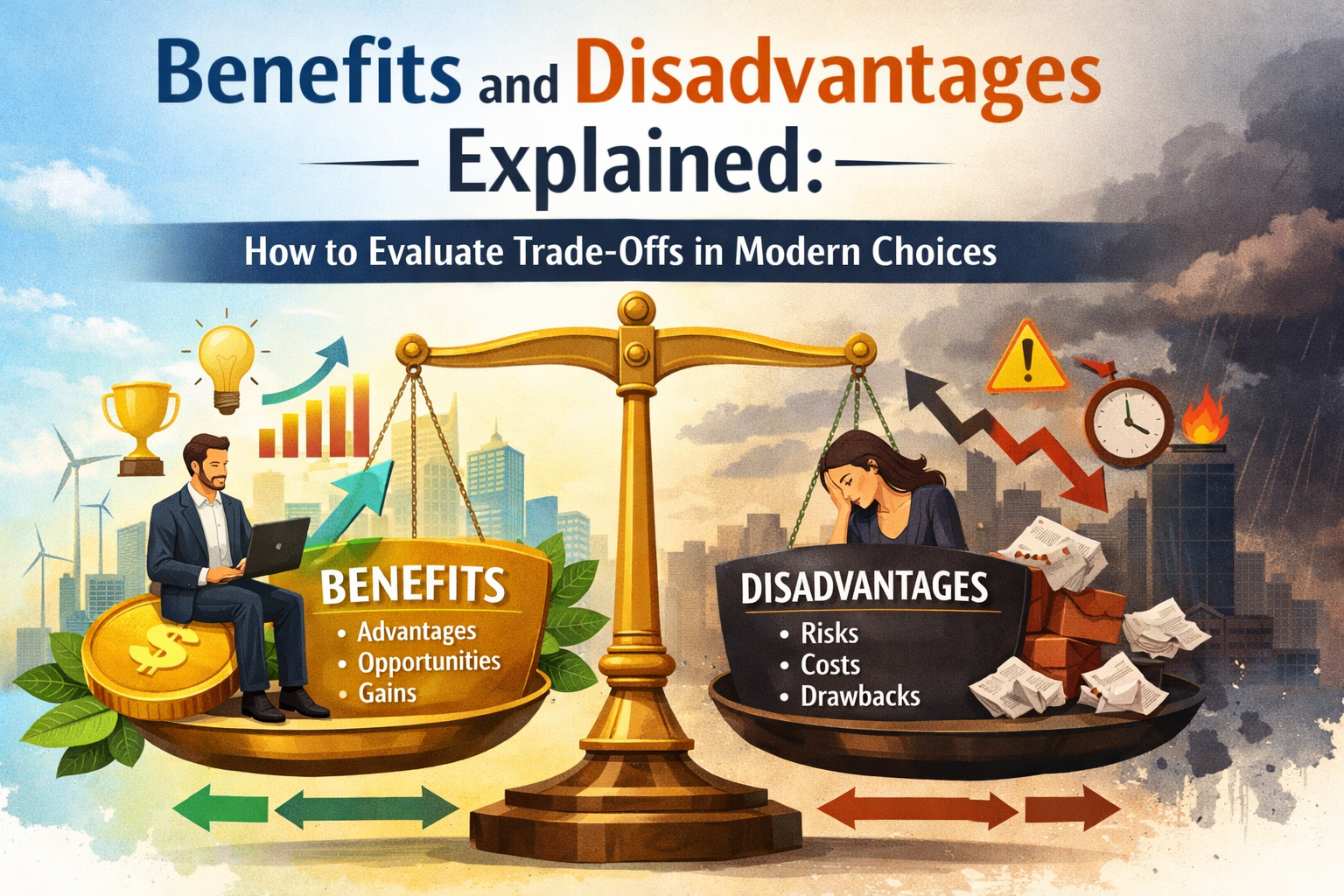
Every meaningful decision—whether personal, professional, technological, or policy-driven—involves trade-offs. The practice of weighing benefits and disadvantages is not merely an academic exercise; it is a foundational principle of rational thinking and strategic planning. From adopting new technologies to implementing organizational changes or public policies, outcomes are rarely one-dimensional.
High-quality decision-making depends on the ability to critically assess both positive and negative implications. Yet, in an era driven by rapid innovation, marketing narratives, and polarized opinions, disadvantages are often under-explored or dismissed entirely. This imbalance can lead to unintended consequences, misallocation of resources, and long-term risks.
This article presents a structured, evidence-based framework for understanding benefits and disadvantages, explains why balanced evaluation matters, and outlines how individuals and organizations can apply this approach to make more informed, sustainable decisions.
The Concept of Benefits and Disadvantages
Defining Benefits
Benefits refer to the positive outcomes or advantages gained from a particular action, decision, or system. These may include:
- Improved efficiency or productivity
- Financial or economic gains
- Enhanced quality of life or user experience
- Competitive or strategic advantage
- Long-term growth or innovation potential
Benefits are often easier to identify because they align with goals, incentives, and immediate rewards.
Defining Disadvantages
Disadvantages represent the costs, risks, or negative consequences associated with the same action or decision. These may include:
- Financial costs or hidden expenses
- Operational complexity
- Social, ethical, or environmental risks
- Long-term sustainability concerns
- Opportunity costs
Unlike benefits, disadvantages often emerge gradually, making them more difficult to recognize at early stages.
Why a Balanced Evaluation Is Critical
Avoiding Cognitive Bias
Human decision-making is influenced by well-documented cognitive biases such as optimism bias and confirmation bias. These tendencies cause decision-makers to overestimate benefits while underestimating risks. A structured evaluation of disadvantages helps counteract these biases and promotes objectivity.
Enhancing Strategic Resilience
Organizations that assess disadvantages alongside benefits are better equipped to anticipate challenges, develop contingency plans, and adapt to changing circumstances. This resilience is particularly important in volatile environments where assumptions can quickly become outdated.
Supporting Ethical and Sustainable Outcomes
Ignoring disadvantages can lead to ethical oversights, environmental harm, or social inequities. A balanced approach ensures that decisions consider broader stakeholder impacts rather than focusing solely on short-term gains.
Benefits of Evaluating Both Sides
Improved Decision Quality
Research in behavioral economics and management science consistently shows that decisions informed by multiple perspectives yield better outcomes. Evaluating both benefits and disadvantages leads to more accurate forecasting and risk management.
Transparency and Accountability
In professional and policy contexts, documenting advantages and drawbacks promotes transparency. Stakeholders are more likely to trust decisions that openly acknowledge limitations and uncertainties.
Long-Term Value Creation
Short-term benefits can sometimes mask long-term disadvantages. A balanced evaluation helps decision-makers prioritize sustainable value over immediate results.
Common Disadvantages of One-Sided Decision-Making
Short-Termism
Focusing exclusively on benefits often leads to short-term optimization at the expense of long-term stability. This approach may deliver quick wins but can create systemic vulnerabilities.
Escalating Costs and Risks
Unexamined disadvantages tend to compound over time. What begins as a minor operational challenge can evolve into significant financial or reputational damage.
Reduced Flexibility
Decisions made without acknowledging downsides are harder to reverse. Recognizing disadvantages early allows for adaptive strategies and exit options.
A Practical Framework for Evaluating Benefits and Disadvantages
Step 1: Clearly Define the Decision Context
Start by identifying the scope, objectives, and constraints of the decision. Ambiguity at this stage often leads to incomplete evaluations.
Step 2: Identify Short-Term and Long-Term Impacts
Benefits and disadvantages should be assessed across multiple time horizons. Immediate gains may differ significantly from long-term outcomes.
Step 3: Consider Multiple Stakeholders
Different stakeholders experience benefits and disadvantages differently. A comprehensive evaluation accounts for diverse perspectives, including indirect or marginalized groups.
Step 4: Assess Probability and Impact
Not all disadvantages carry the same level of risk. Evaluating both the likelihood and potential impact of negative outcomes improves prioritization.
Step 5: Revisit and Update Assumptions
Conditions change. Periodic reassessment ensures that decisions remain aligned with evolving realities.
Data-Driven Decision-Making and Evidence
Balanced evaluation relies on credible data rather than assumptions. Peer-reviewed research, historical case studies, and real-world performance metrics provide valuable insights into both benefits and disadvantages.
For example, studies in organizational management have shown that initiatives with formal risk assessments demonstrate higher long-term success rates compared to those driven solely by projected benefits. Similarly, policy analyses often reveal that unintended consequences emerge when disadvantage assessments are insufficient or absent.
Importantly, evidence should be contextualized rather than generalized. What constitutes a disadvantage in one setting may be negligible or even beneficial in another.
Benefits and Disadvantages in Modern Contexts
Technology Adoption
- Technological innovation offers clear benefits such as efficiency and scalability. However, disadvantages—including security risks, workforce displacement, and dependency on complex systems—must be carefully evaluated to ensure responsible implementation.
Business Strategy
Strategic initiatives often promise growth and market advantage, yet they can introduce operational strain, cultural misalignment, or financial exposure. Balanced analysis supports sustainable competitive positioning.
Public Policy and Society
Policy decisions frequently involve trade-offs between economic growth, social equity, and environmental protection. Transparent evaluation of benefits and disadvantages fosters informed public discourse and better governance.
Common Mistakes to Avoid
- Treating disadvantages as obstacles rather than data points
- Overreliance on best-case scenarios
- Ignoring qualitative impacts that are harder to measure
- Failing to update evaluations as new information emerges
- Recognizing these pitfalls strengthens analytical rigor and decision quality.
Conclusion: Key Takeaways
Evaluating benefits and disadvantages is not about discouraging action; it is about enabling better action. A balanced, evidence-based approach improves decision quality, enhances resilience, and supports ethical and sustainable outcomes.
Key takeaways:
- Benefits highlight opportunity, but disadvantages reveal risk and complexity
- Balanced evaluation mitigates bias and improves long-term outcomes
- Structured frameworks support transparency and accountability
- Data and context are essential for meaningful analysis
- Revisiting assumptions ensures adaptability over time
In an increasingly complex world, informed decision-making depends not on choosing optimism or caution—but on understanding both.